What really is the Syphilis Detection Test?
In simple terms, Syphilis is referred to as a systemic infectious disease that is determined by T. pallidum.
How is Syphilis transmitted?
A person having unprotected sex, which can either be oral, vaginal or anal with a person who has already been infected with Syphilis, will be more sensitive, simply meaning that they will be at a higher risk of getting Syphilis.
Like, in women who are pregnant, this disease can be transmitted from the mother to the foetus directly because the pregnant mother is already carrying the infection.
What symptoms for Syphilis are there?
The symptoms are the same for both men and women; however, the symptoms may also vary depending on what stage the infection is currently at. However, you can also have the infection and still not show any symptoms.
If left non-treated, it develops in following four stage(s):
- The primary stage
- The secondary stage
- The latent stage
- The tertiary Stage
In the primary stage, a painless ulcer on the part which has been in contact with the bacteria can be seen. This can come after 2-3 weeks and can last for up to 5-6 weeks. Depending on where the infection is, it can disappear unobserved.
The secondary stage will most commonly come up with some of the symptoms like skin rash (usually on hands and feet), inflammation of the genitals, swollen glands, and visible white spots on the mouth. What is significant to note is that in such a condition, even if no treatment is given, the symptoms will usually disappear, but the infection will progress to the next stage.
In the latent stage when the secondary stage of Syphilis disappears, the symptoms can not show up for a few years, even if the infection is there.
In the tertiary stage which comes after a couple of years since the affected person’s infection has serious effects on cardiovascular, neurological or osteo conditions.
How does the Syphilis diagnosis take place?
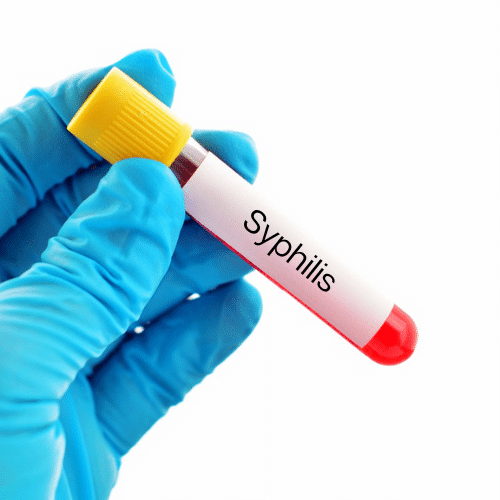
The process of diagnosis involves conducting a Syphilis blood test.
The Prevention:
The only way you can reduce the risk of getting infected is by using protection (a condom). It is also important to note that if you are currently undergoing treatment, it is recommended that you have sexual contact only after you finish the treatment and once the symptoms are no more present.
Why should you choose us?
- We provide the latest laboratory technology
- We deal directly and provide the best laboratory prices
- We provide the best support
- We issue the Result Certificate by way of confidential email (NO SMS) to protect your privacy
- We only use MHRA-registered IVD devices
- We provide additional support via WhatsApp during business hours
Sharing Syphilis Blood Test stories helps you and helps others.
Do you have a story to tell about infection? Maybe you were diagnosed with syphilis and can help other people know more about what it was like? Are you a researcher, policy maker or educator with something to say about syphilis tests? Do you know about STD testing? Or are you a health worker who has checked, diagnosed or treated syphilis? Get in touch to share your story.
Rianna (London)
Our sexual health services across the country have changed how they deliver healthcare since COVID began. During this time, I’ve worked as a Sexual Health Advisor for an integrated sexual health service in East London. I’ve noticed a recent increase in patients testing positive for syphilis during pregnancy. Frequently, patients test positive via antenatal clinics and end up being referred to our service for treatment.
I am also seeing that a lot of women don’t know that if you get it during pregnancy, the infection can cause serious problems, including miscarriage or stillbirth. If it remains untreated during pregnancy, then babies can be born with it – a severe and often life-threatening infection in infants.
For some of the women, this exam happens to be the first and only STD Profile test they’ve ever had, so naturally, the result can come as a shock. For other women who have had sexual health screens in the past and have received negative results, a positive diagnosis can also come as a surprise.
However, whatever the situation, my job is always to provide the patients I see with information. I explain the routes of transmission and symptoms. I encourage and support them to inform their recent sexual partners to get checked and treated. Honestly, I suggest treatment and explain their responsibilities for future STD home testing to protect themselves and their partners.
Want to know your sexual health status? Do a full sexual health screening NOW!
Billie (London)
When Billie got a call from a friend he’d had a threeway with, he was advised to go and get treated.
A few weeks ago, I went on a three-way trip with a friend, Carlos, and his partner. He called me to say he was positive. He’d been for his regular HIV appointment and had asked the doctor to look at a sore on his penis.
The doctor said she was pretty sure it was syphilis, took some tests, and started him on treatment straight away. When Carlos called me from the clinic to tell me, he said the doctor advised me to come in to be checked. Just to be sure.
The treatment
Carlos mentioned that the treatment he’d just had was uncomfortable. But I wasn’t ready for what waited for me at the clinic! The doctor took a checkup and then advised me to get treated anyway before waiting for the results to return.
Because I was going away for work later that month, I decided to have the treatment. The nurse asked me to take my trousers down and get on the couch. The poor nurse! I’ve never sworn so much during a medical appointment! Just as I got off the couch and started buttoning up my jeans, the nurse told me to get back on the couch because there was another injection to do.
A week later, I got a call to say that the syphilis blood exam had come back negative. I don’t regret being treated. I know if I’d waited and it had developed, the treatment would have involved more injections.
I’m also glad that Carlos told me he could’ve waited to see if his results came back positive. But he trusted me to make my own decisions with my health.
Jamie
I’ve had it a couple of times. The very first time I had it, I found out through a routine check that I didn’t have any symptoms. I was relatively aware of sexual health and the symptoms of STIs. In the past, I was already diagnosed with HIV, so it wasn’t a huge thing for me.
I saw it as something that affected people in olden times. My only association with it was that it killed monarchs. I felt like it didn’t come up as much as other STIs. I felt like HIV was always at the forefront of sexual health for queer men. But it wasn’t talked about as much.
Previously, I had a negative experience at a sexual health screening years ago where a nurse made me feel alienated. She didn’t recognise my symptoms, and I was being blamed for the return of gonorrhoea in the UK because I said I didn’t know where it came from. I think she was homophobic, seeing my sex life as a cultural issue. At the time, I was only sleeping with one person. I was treated even though they didn’t check me, which is different now because there are fears of antibiotic resistance.
The stigma
I had an issue where I couldn’t hear properly as if someone had their hand over my ear. I went to my GP, who rinsed it out. No change. Nothing. Around the same time, I had an HIV appointment. I came into contact with syphilis, and I told the HIV doctor that I also had impaired hearing in one ear. She looked at me, concerned, and, Syphilis can cause deafness”. My world collapsed. It turns out that after she spoke to a colleague, I went back to the GP. That deafness was a symptom of very advanced, but what I had was very advanced ear wax.
I don’t know why it gets such a bad rep. People don’t talk about it much. It was treated, and it cleared up very quickly.
Phil
In Phil’s Story, he discusses the first time he had it. And the difficulty in disclosing his diagnosis to his partners.
I last had it was about three years ago when I developed a rash on my upper body that wouldn’t go away. I visited my GP, thinking it was something like a skin problem. After examining me for a while, she suggested that I go and have an exam as it might be syphilis. I thought she must have been mistaken as I had not experienced the common earlier symptom of a sore on my genitals (called a chancre sore), but I booked in for a exam at 56 Dean St in London right away.
When I got to the clinic, they looked at my rash and did some weird reflex exams, and they were pretty certain that it was it. They treated me for it while I was there. The treatment was a rather large injection into my bum cheek, which left it numb for quite some time.
After the treatment
This was the first time I’d had it, and I didn’t know too much about it. It felt like it was something you only heard about in some BBC period drama. That was a similar reaction when I told those I needed to about it, too. Because of this I admit I felt quite uncomfortable with it, it seemed to have a bit more stigma than other more commonly spoken about STIs. I think this has a lot to do with how it can develop in the later stages of the disease.
While at the clinic, they gave me a leaflet about an STI ervice to tell my partners, but I thought I would be fine telling them myself. This was a bit of a chaotic time of my life, which involved regular group sex. I couldn’t narrow it down enough to one or two people, so I had to message a handful of people. This task dawned on me when I messaged the first guy, who immediately denied that he would have it and said that I shouldn’t message him again. Crikey! I messaged the others, and it was a mixed reaction; some were acting as if they were too pure to get an STI, but the others were more understanding.
I guess I had expected everyone to be understanding, especially as there was a good chance I could have got it from any one of them. The bad reactions just added to my anxiety around having it, and because of this, I didn’t discuss it with my friends through that same fear.
Shipping and Return Policies
Appointment:
Missed appointments or cancellations less than 24 hours prior are not entitled to refunds. Rescheduling is possible but not guaranteed. Please contact the customer service prior to the appointment time to discuss cost and availability options.
Shipping & Return:
We have a 14-day return policy, which means you have 14 days after receiving your item to request a return.
To Qualify for any return, the product must be in the same condition as when you received it. Not used, not opened, unworn, in its original packaging. You will also need to send it to us with the receipt or proof of purchase.
Please return to: Medicines by MailBox, 89 Falcon Rd, London. SW11 2PF
You can read our full return policy here:
https://medicinesbymailbox.co.uk/return-policy/
We offer next day delivery; however courier delivery times are out of our control. We are unable to offer refunds for any late deliveries. But you will receive courier tracking information once your order has been dispatched. And orders placed by 1pm are dispatched on the same day.
What is the Syphilis Test Kit Shipping and Returning Policy ?
Our return policy is of 14-days, meaning you will have 14 day after getting your STI order to request a return.
For the delivered kit to qualify for any return, the Syphilis Kit product must be the same as it was when is got delivered. Please also make sure that the kit is in its original packaging without any signs of use. You must attach the receipt of returns.
Address details for returning your order is as follows, Ascot Pharmacy, 61 Falcon Rd, London. SW11 2PG. The full return policy is mentioned in the given link below.
https://ascotpharmacy.co.uk/return-policy/
Certain points about Royal Mail and DHL Courier Services: We offer next-day delivery; however, please note that the courier delivery times are out of our control and therefore we are not able to offer any refunds for late deliveries. However, once your order has been dispatched you will receive courier tracking information which you may use to track the delivery. Please also note that the orders placed at or before 1 PM will be dispatched from the lab on the same day.












Andy Barton –
Good product I must say with the customer executives at their disposal almost all the time.
Linda –
Wp support was of great help to me they cleared my doubts and paved the way for a smoother testing experience.
Penelope T. –
The home test kit I ordered arrived quickly, and the instructions were clear. I felt supported throughout the process!
Lily G. –
I had a few questions about my order, and the customer service team was incredibly helpful. They responded quickly and resolved my issues.
Salena D. –
Top-notch customer support! The team went above and beyond to ensure I had a smooth experience with my health testing!